Insidious: Out of the Further
A 2026 American supernatural horror film and the sixth chapter of the Insidious series, introducing a new family whose mother can bring the dead back through the barrier between worlds.

At a glance
- Release
- 21 August 2026 (US)
- Director
- Jacob Chase
- Screenplay
- Jacob Chase
- Story
- David Leslie Johnson-McGoldrick, Jacob Chase
- Runtime
- 105–106 minutes (sources differ)
- Rating
- PG-13 (US)
- IMDb
- tt32393988
- Studio
- Screen Gems / Blumhouse / Atomic Monster
- Series
- Insidious, film 6
Overview
Insidious: Out of the Further is a 2026 American supernatural horror film and the sixth instalment in the Insidious franchise created by James Wan and Leigh Whannell. It was directed by Jacob Chase, whose previous feature was Come Play (2020), and stars Amelia Eve as Gemma, a young mother who discovers that she can enter the Further — the purgatorial realm of lost souls at the centre of the series — and, more dangerously, bring what lives there back into the ordinary world.
The film also marks a structural change. After five films built around the Lambert family, the story follows a new family and a new set of characters. Lin Shaye returns as the psychic investigator Elise Rainier, the only performer to have appeared in every instalment, but the centre of gravity has shifted to Gemma, her daughter Maya, a local police officer named Nick Mendoza and a demonic presence called Cyrus Lam. The official synopsis promises "a terror that redefines what The Further is capable of".
The film was released in the United States on 21 August 2026, after being moved from an earlier 2025 date. It carries a PG-13 rating and a runtime listed at roughly 105 to 106 minutes. Its marketing tagline — "Evil found a way out" — captures the new premise in four words: the danger is no longer confined to the spirit realm but has been given a route into the living one.
This guide covers the film's place in the franchise, its story and characters, its production team, its release and reception, and the themes that connect it to the earlier films. Where sources disagree — the runtime is one example — the disagreement is stated rather than smoothed over.
"Having earned over $740 million at the global box office, the Insidious franchise returns with a new family and a terror that redefines what The Further is capable of." — Official synopsis, Sony Pictures UK
The Further, explained
To understand Out of the Further, it helps to understand the rules of the world it extends. The Further is a dimensional realm that exists alongside ordinary life. It is populated by lost souls and by entities that were never human, and it can be reached through astral projection — the deliberate separation of the spirit from the body. In the first film, Josh Lambert travels there and is changed by what he finds. Later films explore the realm from different angles: as a prison, a hunting ground and a place where the dead can be contacted.
The franchise's horror comes from permeability. The Further is not sealed away; it leaks. Doors appear in unexpected places, lights flicker, and figures move at the edge of vision. Characters who think they are safe in their own homes discover that the boundary is thinner than they believed. This is why the red door became the series' defining image: it is an ordinary object that functions as a threshold.
Earlier protagonists could generally travel in one direction and return changed. Gemma's ability is new because it works both ways. She can enter the Further and can also bring entities back with her. That reversal is the film's central innovation and the source of its title. If the demons learn that a living person can act as a gate, the barrier that protected the real world stops being a barrier at all.
The Further also has a social structure. The series has introduced spirit guides, Contracted souls, demonic entities with specific habits and rules, and human beings who have become trapped between worlds. Out of the Further builds on this by introducing Cyrus Lam, described in studio materials as a former cult leader stuck in the realm who promises other trapped souls a way back to the living world. His scheme gives the film a political dimension inside the mythology: the demons are not merely destructive but organised.
Story and characters
Gemma and the house
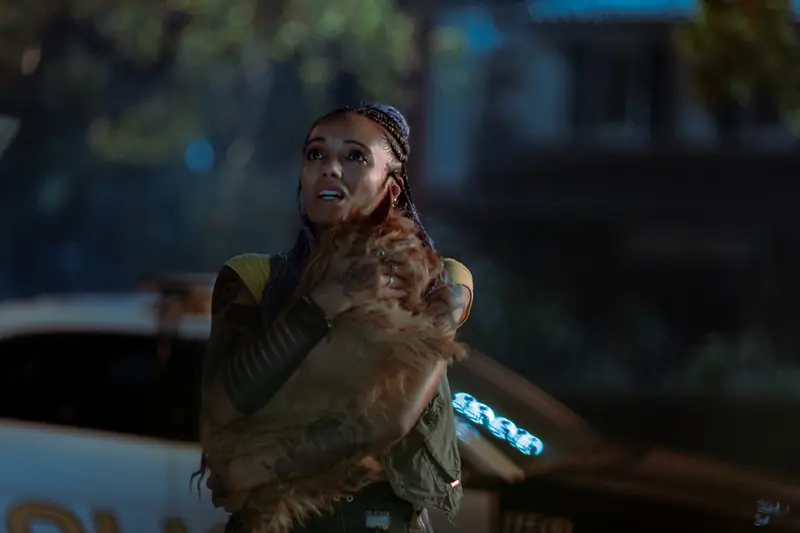
Gemma Hall is a young mother raising her daughter Maya in the house in which she grew up. That detail matters. The house is a place of family memory, and the return to it suggests that the past has been waiting rather than gone away. Gemma's discovery that she can travel into the Further is presented as an unwanted ability rather than a gift. She does not seek the realm; it opens to her, and once it has, she cannot close it again.
Her daughter Maya, played by Island Austin, is the emotional centre of the story. Gemma's decisions are shaped by the need to protect a child who cannot protect herself, a inversion of the Lambert family's earlier father-centred arc. Where Josh and Dalton Lambert confronted the Further from the position of sons and fathers, Gemma confronts it as a mother.
The ability and its consequence
The official synopsis is explicit about the mechanism. Gemma "discovers an ability that changes everything: she doesn't just enter The Further, she can bring what lives there back to the real world. Once the demons realise her power, our world becomes their playground." That is the film's engine. Every subsequent event follows from other characters learning what she can do and trying to use, control or stop it.
The consequences are staged through a series of escalating encounters. Early disturbances are domestic and intimate — rooms that should be empty, sounds that should not exist, a child's safety that cannot be guaranteed. Later incidents widen in scale as more entities cross over and the ordinary rules of the neighbourhood begin to fail. The film uses the contrast between a familiar house and an unfamiliar invader as its primary source of dread.
Allies and adversaries
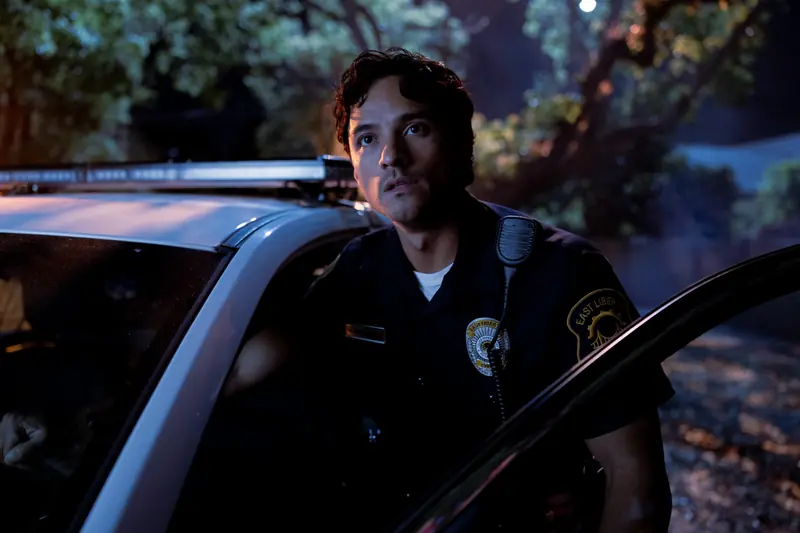
Nick Mendoza, played by Brandon Perea, is a local police officer who befriends Gemma and Maya. His profession gives him access to the practical side of the crisis — reports, missing persons, the suspicion of neighbours — while his friendship gives the story a source of support that is not defined by the supernatural. Clare, played by Maisie Richardson-Sellers, helps Gemma navigate the Further, functioning as the more experienced guide in a story where the protagonist is learning the rules too late.
Elise Rainier returns once more. Lin Shaye's character is the franchise's constant: a medium who first helped the Lambert family and who has continued to appear across the series, including after her death, as a spirit within the Further. Her presence links the new story to the old one without requiring the Lamberts to return. It also gives the film someone who can explain the rules without turning the screenplay into a lecture.
Cyrus Lam is the antagonist. Studio materials describe him as a former cult leader trapped in the Further who offers the other Acolytes a path back to the living world. He is played by Sam Spruell. This is a more articulate villain than the series' usual predatory presences: he has a plan, a constituency and a pitch. That makes Gemma's ability not merely dangerous but politically valuable to the realm she can access.
The sequences that define the film
Horror films are often remembered less for plot than for individual scenes, and audience discussion of Out of the Further has concentrated on a small number of set pieces. Their effectiveness comes from the same principle: an ordinary environment is made wrong by something that should not be there.
The pillow fort
Among the most frequently mentioned scenes is a claustrophobic sequence involving a pillow fort — a child's improvised shelter that becomes a place of entrapment. The brilliance of the setting is its familiarity. Nothing about a fort built from cushions is frightening in itself, but the film uses its enclosed geometry to make escape feel impossible. Viewers praised the scene for its sustained tension and for the way it turns a symbol of safety into a trap.
The dentist sequence
Another widely discussed moment takes place in a dental setting. The dental chair is a rich location for horror: the patient is immobilised, the practitioner leans over them, and instruments are designed to enter the body. The film draws on that discomfort and then shifts it into supernatural territory. Reports on audience reaction singled the sequence out as one of the film's most unsettling, precisely because it starts from a situation many viewers already associate with vulnerability.
Domestic disturbances
Between the larger set pieces, the film relies on smaller disturbances: sounds from empty rooms, objects in the wrong place, a door that should not be open. These moments do the work of keeping the household unstable. Their purpose is not to surprise but to prevent the audience from ever feeling that the family has regained control. By the time a major scare arrives, the viewer has already accepted that any surface might be a threshold.
Crossing over
The scenes inside the Further are staged differently from the domestic ones. Light behaves unnaturally, spaces are larger than they should be, and familiar landmarks appear distorted. Gemma's movement through this realm is the visual counterpart to the film's premise: she is not a warrior entering a monster's lair but a parent searching for a way to protect her child. That emotional motive keeps the supernatural geography from becoming abstract.
Taken together, these sequences show how the film balances innovation and convention. The settings are familiar horror locations — the home, the car, the medical room — but the underlying rule, that a living person can import the dead, is new to the series. The tension comes from that mismatch between old images and a new mechanism.
Cast and characters
| Performer | Character | Role in the story |
|---|---|---|
| Amelia Eve | Gemma Hall | A young mother who can enter the Further and bring entities back. |
| Island Austin | Maya Hall | Gemma's daughter and the person she is trying to protect. |
| Brandon Perea | Nick Mendoza | Local police officer who befriends the family. |
| Maisie Richardson-Sellers | Clare | A woman who helps Gemma navigate the Further. |
| Sam Spruell | Cyrus Lam | A former cult leader seeking a way back from the Further. |
| Lin Shaye | Elise Rainier | The returning psychic investigator of the Insidious series. |
| Laura Gordon | Credited supporting role | Member of the ensemble cast. |
| Joseph Lopez | Credited supporting role | Listed among the principal cast in regional databases. |
Amelia Eve came to broad attention through The Haunting of Bly Manor, a role that required sustained emotional tension in a haunted-house setting. That experience is directly relevant here: much of the film asks her to react to threats the audience can barely see. Brandon Perea's background includes Nope, a film built around the difficulty of perceiving something enormous and strange. Lin Shaye needs no introduction within the franchise; her return provides continuity for viewers who have followed all six films.
The cast is deliberately smaller and more focused than the sprawling ensembles of some recent horror sequels. The story is built around one family, one officer, one guide and one antagonist. That economy allows the film to spend time on domestic spaces rather than on an ever-expanding roster of victims.
The five films that came before
The original Insidious (2010) was made by James Wan and Leigh Whannell on a budget reported at around 1.5 million dollars and earned approximately 100 million worldwide. Its central device — a family whose son falls into a coma after an accident and begins travelling astrally — established the rules of the Further and introduced Elise Rainier. The film's success was unusual because it relied on atmosphere and gradual revelation rather than on the torture imagery that dominated horror at the time.
Insidious: Chapter 2 (2013), again directed by Wan and written by Whannell, continued the Lambert story directly and grossed around 162 million dollars on a five-million-dollar budget. It deepened the mythology around the Further and the idea that dead souls can attach themselves to the living. Chapter 3 (2015) moved backwards in time. Whannell made his directorial debut with a prequel centred on Elise, and the film earned roughly 113 million. The shift to prequel storytelling allowed the series to explore how Elise first learned to help people cross boundaries.
Insidious: The Last Key (2018), directed by Adam Robitel, was another prequel and another Elise-centred story, this time returning to her childhood home. It grossed about 168 million dollars. The film's structure — an investigator confronting the house that formed her — is a direct ancestor of Out of the Further, which also returns a protagonist to the house she grew up in. The pattern suggests that the franchise treats home as the place where suppressed history becomes physically present.
Insidious: The Red Door (2023) brought the story forward again. Patrick Wilson made his directorial debut with a sequel to the first two films, focusing on a now-grown Dalton Lambert and his relationship with his father. It became the highest-grossing film in the series at approximately 189 million dollars. Its emphasis on inherited trauma and a father-son reconciliation is the emotional model that Out of the Further adapts into a mother-daughter story.
Across those five films, the series moved from a single family outward: to Elise's past, back to the Lamberts, and now to an entirely new household. The pattern explains why the sixth film can feel both familiar and new. The cosmology is stable; only the people inside it change.
Production
Director and writers
Jacob Chase directed the film and wrote the screenplay. The story was written by Chase together with David Leslie Johnson-McGoldrick, whose credits include The Conjuring 2 and Aquaman. Chase first became known through short horror films and then directed Come Play, a 2020 feature about a monster that appears through a tablet screen. That film was built around a single technological object becoming a threshold; Out of the Further applies a similar idea to a human being.
The producers were Jason Blum, Oren Peli, James Wan and Leigh Whannell, with Steven Schneider, Ryan Turek and Brian Kavanaugh-Jones as executive producers. The screenplay is based on characters created by Whannell. This combination places the film squarely inside the established production lineage of the franchise while giving a new director room to define the tone.
Design and craft
Cinematography was handled by Dave Garbett, and the score was composed by Joseph Bishara, a frequent collaborator with James Wan whose work in the Conjuring universe and the original Insidious films relies on low drones, dissonant textures and abrupt silences. The production companies listed for the film include Blumhouse Productions, Atomic Monster, Screen Gems and Stage 6 Films.
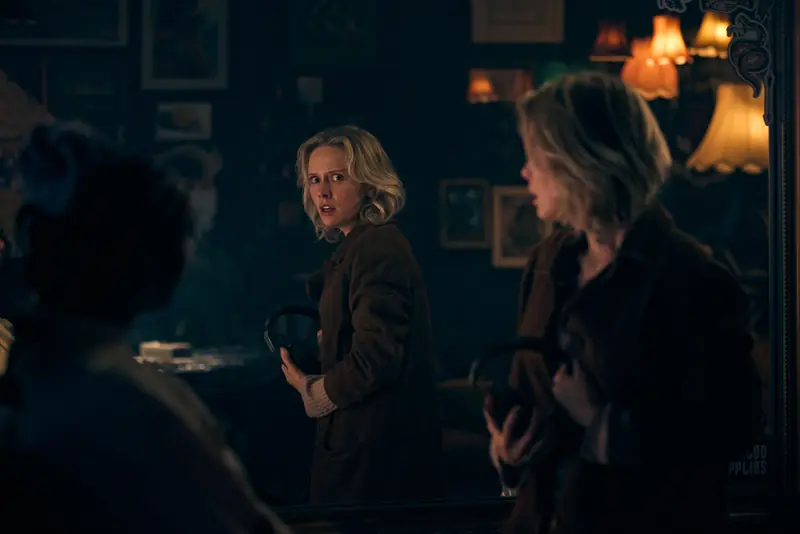
The film's visual strategy uses familiar environments — a childhood home, a car, a police station, a dentist's office — and gradually introduces impossible details. This is consistent with the franchise's long-standing habit of making ordinary interiors feel unsafe. Promotional stills provided by Sony emphasise hands, rings and occult objects, close framing and deep blue-green shadows. The approach suggests that the threat is intimate rather than monumental.
Sound, score and atmosphere
The Insidious films have always relied on sound as much as image. Joseph Bishara's scores use sustained low tones, metallic textures and sudden absences of noise to make the audience anticipate a threat before it appears. The technique is effective because it works on expectation: a quiet room is not frightening until the viewer has learned that quiet precedes something. Bishara's return for Out of the Further gives the new film an immediate sonic continuity with the earlier chapters.
Sound design carries the specific business of the Further. Whispers, distorted speech and the sense of movement just outside the frame are used to suggest that the realm is always adjacent. When an entity crosses into the living world, the soundscape changes in a way that tells the audience the rules have shifted even before the image confirms it. Reports on audience reaction repeatedly praised the film's sound design, which suggests that this aspect of the craft remained effective for viewers in a theatre.
Cinematographer Dave Garbett's images support that approach. The film's stills show deep teal shadows and narrow pools of warm light — a palette that makes domestic interiors look like places where something has been hiding. Close framing on hands, faces and objects concentrates attention on small details. This is a visual strategy built around withheld information: the camera shows enough for the viewer to sense a threat but rarely enough to understand it fully.
The combination matters because the premise could easily become absurd. A woman who can import demons into the real world is, on paper, a very large idea. The film keeps it intimate by staging its consequences in small rooms and ordinary objects. The score and sound design do much of the work of making that scale feel plausible.
Marketing and release strategy
The campaign for Out of the Further leaned on two recognizable assets: the Insidious brand and the returning Lin Shaye. The first poster showed a woman's face inverted beneath a clawed hand, with the tagline "Evil found a way out" and the title rendered in the series' familiar red and white lettering. Trailers followed the established pattern of glimpsed figures, flickering lights and a final reveal designed to circulate in social media clips.
The release date was part of the strategy. After an initial plan for 29 August 2025, the film moved to 21 August 2026, placing it in the late-summer window before the autumn horror season. Sony's international rollout included a UK presence, and the film became available through major digital retailers after its theatrical run. Regional release dates varied slightly, with some markets opening on 19 August.
Marketing also had to explain a change. This was the first Insidious film without the Lambert family at its centre. The solution was to lead with the new premise — a mother with an impossible ability — while prominently featuring Elise as a guarantee that the series had not abandoned its identity. The studio's synopsis described the franchise's 740-million-dollar history in the first sentence, using commercial success as a signal of trustworthiness.
Release and franchise context
The film was originally scheduled for release on 29 August 2025 but was delayed, eventually opening in the United States on 21 August 2026. It was rated PG-13. Regional listings give slightly different runtimes — 105 minutes in some markets, 106 in others — and Taiwanese listings give 19 August for that market's opening.
The Insidious franchise began in 2010 with James Wan's original film, which premiered at the Toronto International Film Festival and earned around 100 million dollars worldwide against a budget of roughly 1.5 million. Chapter 2 followed in 2013 with about 162 million worldwide on a five-million-dollar budget. Leigh Whannell directed Chapter 3 in 2015, a prequel that grossed around 113 million, and Adam Robitel directed The Last Key in 2018, which earned about 168 million. The Red Door, directed by Patrick Wilson in 2023, became the franchise's highest-grossing entry at roughly 189 million.
Sony's official description states that the series has earned more than 740 million dollars globally. Out of the Further is the sixth chapter and the first to move away from the Lambert family as its central focus. That decision answers a question the series had been circling for years: how long a franchise can sustain one family's trauma before the story needs new people. The studio's answer is a new family in a familiar cosmological system.
Reception
Early audience reaction was mixed but generally warmer than for the two preceding entries. Reports summarising social responses noted praise for the film's jump scares, its sound design and a handful of inventive sequences. A claustrophobic pillow-fort or crawlspace scene and an unsettling dentist sequence were repeatedly singled out as highlights. Amelia Eve's performance as a mother under pressure and Lin Shaye's return were also commonly mentioned positively.
The most frequent criticism was familiarity. Viewers and reviewers who found the film predictable argued that it follows a well-worn path and loses momentum in its later sections. Some described the experience as akin to a well-crafted haunted-house attraction: effective in the moment but not especially lingering. One published assessment gave the film a middling score, calling it a solid but familiar entry that delivers for franchise fans while rarely feeling fresh.
That divide is typical of long-running horror series. Viewers who value atmosphere and craft in familiar surroundings tend to respond well; viewers looking for reinvention are more likely to be disappointed. Out of the Further does attempt one significant change — the reversal of who can cross the boundary — but it wraps that idea in the visual and structural language that audiences associate with the earlier films.
The film's critical reception should be read with one caution. Much of the available commentary consists of aggregated audience reactions rather than a broad body of formal reviews, and some sources are explicitly based on social media discussion. The safest conclusion is that the film satisfied its core audience while doing little to change wider opinions about the franchise.
Themes and analysis
Motherhood as a horror engine
The shift from the Lambert family to Gemma and Maya changes the emotional geometry of the series. The earlier films were organised around fathers and sons, with mothers often positioned as people who did not fully believe what was happening. Here the protagonist is a mother whose child is directly exposed to the danger she has unleashed. Guilt and protectiveness therefore drive the plot more strongly than curiosity or redemption.
Borders and contamination
Every Insidious film is concerned with thresholds: doors, windows, sleep, coma, astral projection. Out of the Further radicalises that concern by making a person a threshold. Gemma's body becomes the boundary. The horror is not simply that monsters exist but that they can use her to arrive. This turns a supernatural rule into a metaphor for vulnerability — the fear that something you cannot control has access to the people you love.
Organised evil
Cyrus Lam is a cult leader rather than a mindless entity. That choice gives the film an unusual structure for a possession-era horror story. The antagonist makes an offer to other trapped souls: a route back to life. Evil is therefore persuasive and collective, not just predatory. This reflects a broader strain of modern horror in which the monster's power comes from its ability to recruit.
Why the old guard still matters
Elise Rainier's return is more than fan service. In a film about a new family learning rules too late, she is the character who already understands the cost of crossing over. Her presence allows the screenplay to connect the new story to the earlier films without dragging the Lamberts back into the plot. She is a bridge between eras, much like the franchise itself.
Familiarity as a feature
For all the complaints about formula, the series' consistency is part of its appeal. Audiences return for particular sensory experiences: the sound design, the slow reveal in a dark corridor, the moment an ordinary room becomes wrong. Out of the Further delivers those beats reliably. Whether that counts as a strength or a limitation depends largely on what a viewer wants from a sixth instalment.
Position in the franchise and what comes next
Out of the Further occupies an unusual position in the Insidious series. It is a sequel that behaves like a soft reboot: the cosmology and one returning character are intact, but the emotional centre has moved to a new family. That arrangement solves a problem that had become increasingly visible as the Lambert story continued — the difficulty of sustaining credible danger for the same people across multiple films. New characters allow the rules to be explained again without the artificiality of a full origin story.
The film also expands what the Further can do. Earlier chapters treated the realm as a place the living could visit at a cost. Gemma's ability makes it a place that can reach back. That change has consequences for any future instalment: once the barrier has been shown to be permeable in both directions, later stories must account for it. The film's final movement therefore does more than resolve one family's crisis; it alters the franchise's rulebook.
Reception will likely determine whether that alteration becomes a lasting part of the series. If the film performs solidly, the new family could carry further chapters in the way the Lamberts once did. If not, it may be remembered as an experiment that tested whether the franchise could survive without its original household. Either way, the decision to introduce a mechanism as significant as Gemma's suggests that the filmmakers were not simply repeating the earlier formula.
For viewers, the film is easiest to approach as a standalone horror story with a recognizable backdrop. Knowledge of the earlier films enriches Elise's return and clarifies the history of the Further, but the mother-daughter plot works on its own. Conversely, viewers who know only the first film will recognise the core ideas: astral travel, a hostile spirit realm and the danger of bringing something home. That balance between accessibility and continuity is the film's most practical achievement.
The wider horror landscape is also relevant. Recent years have seen a Generation X-oriented wave of legacy sequels alongside a taste for contained, domestic scares. Out of the Further draws on both: it returns to a brand with decades of audience familiarity but stages its best moments in small, enclosed spaces. Whether that combination is seen as a confident evolution or a safe compromise depends on the viewer. What is clear is that the franchise has chosen to continue by changing its protagonists rather than by ending the story.
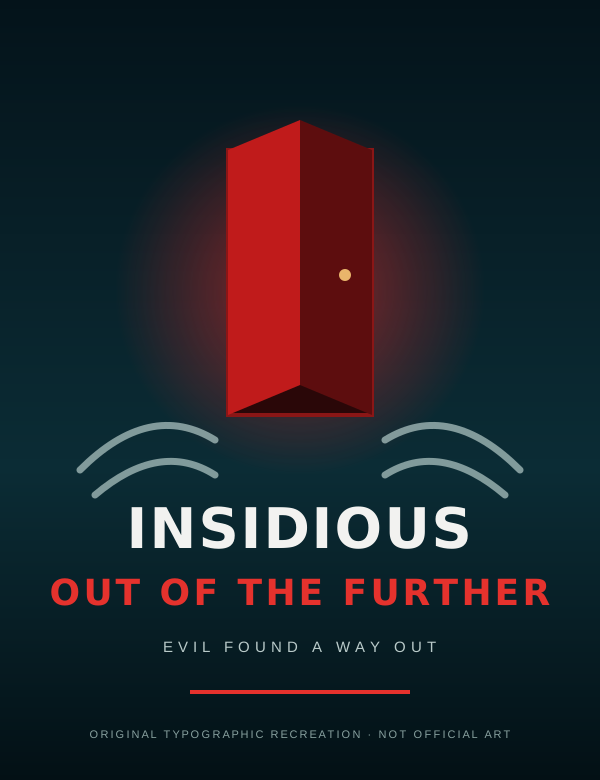
A typographic recreation of the key art
Alongside the promotional photography, this guide includes an original text-based reinterpretation of the film's visual identity. It replaces the photographed face with an open red door — the franchise's defining image — and uses a teal palette with reaching hands to suggest the boundary between worlds. It is offered as commentary, not as official artwork.
Frequently asked questions
When was Insidious: Out of the Further released?
It opened in the United States on 21 August 2026, after being moved from an earlier 2025 release date.
Is it based on the Lambert family?
No. It introduces a new family centred on Gemma Hall and her daughter Maya, though Lin Shaye returns as Elise Rainier.
Who directed it?
Jacob Chase, who also wrote the screenplay. The story was written by Chase and David Leslie Johnson-McGoldrick.
What is The Further?
A dimensional realm of lost souls and malevolent entities that can be reached through astral projection. It is the central supernatural location of the Insidious series.
What is Gemma's ability?
She can travel into the Further and bring entities from it back into the living world — a reversal of the usual one-way crossing in earlier films.
How long is the film and what is its rating?
It is rated PG-13 in the United States and runs approximately 105–106 minutes, depending on the listing.
Sources and external links
- Sony Pictures UK — official film page: synopsis, cast, credits and official stills.
- Rotten Tomatoes — everything we know: director, cast, story and franchise history.
- Rotten Tomatoes — film page: release and reception metadata.
- Sogou Baike — 潜伏6:暗线: IMDb identifier, runtime and release history.
- ATMovies — film data: regional release date and runtime.
This page is an independent, informational fan guide. Insidious and all related marks are trademarks of their respective owners. Promotional images are used for identification and commentary.
Reader discussion
Comments appear live. Your name links to your website; links are marked
nofollow. Basic HTML is allowed in comments.Comments
No comments yet. Be the first.